
QR Code vs. Barcodes: What’s the Difference?
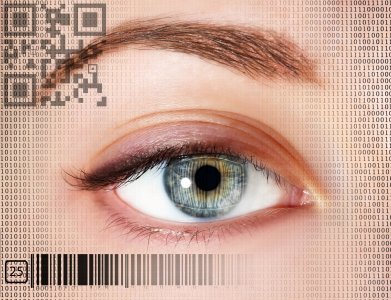
When they first came out, many people were baffled by the cryptic symbols on their items and produce. “A QR code?” they asked. “What’s that?”
Today, those strange squares are commonplace. While QR code use in Japan and China has been widely established, North America continues to rely heavily on regular barcodes for merchandising needs and customer use.
Let’s answer the questions many have wondered about QR codes and barcodes: Which is which and what’s the difference?
Barcode Types
Contrary to popular belief, there are several different types of barcodes.
UPCs (called “EAN” codes internationally) are the “old school” ones we all recognize when we go to the store. They’re made up of a bunch of black lines with numbers underneath.
There are also PDF 417s, which are found on driver licenses, and the GS1 databar on prescriptions and other important documents.
And finally, there are QR codes, which are actually a type of barcode themselves. Does this bring to mind that adage you may have learned in math class: that a square is a rhombus, but a rhombus is not a square? It’s very similar.
However, when we refer to “barcodes” in this article, we’ll be discussing 1‑D codes. More on that later.
QR Code vs. Barcode
Sure they look different, but what are the functionalities of QR codes and regular barcodes? From their history to how they work, we’ll cover the distinctions of both.
| QR Codes | Barcodes | |
|---|---|---|
|
Quick‑response (QR) codes are one of the newest ways to store information on products. Like barcodes, they are in basically every store across the US and Europe. |
The typical barcodes you see at the store also contain information, although not as much as QR codes. Still, they are able to relay all the relevant data needed to process and keep track of goods. |
|
| History |
The first QR code was created in the 1990s by Denso Wave, Inc., a company that provides solutions for automation and robotics. It was used to track vehicles. Although the company received much attention for the creation, QR codes aren’t copyrighted or patented, and so are free to use. |
The first barcode was scanned in 1974 on a pack of Wrigley’s gum. As he sat at an Ohio beach, Joe Woodland, the inventor, imagined the technology that would one day be incorporated into practically every sector of America. He traced it into the sand as he thought about Morse code. |
| How They Work |
QR codes work through algorithms, specifically the Reed‑Solomon error‑correcting algorithm. All the small boxes that make up the code have specific uses. They include several basic parts:
As you can tell, more is stored on these small squares than meets the eye. When these are scanned, the data triggers an event to occur. That’s why if you scan one on your smartphone, it might bring you to a website. |
The “zebra stripes” on barcodes actually have a significant role in the storing of data. In the usual EAN system, 13‑digit numbers store information. Bars represent each number and are a specific length and width. Computers read this information. |
| Advantages |
QR codes offer several advantages. First, they are smaller, meaning businesses can use more of a product’s outside for marketing and branding. They are also easier to access, as they can be read horizontally or vertically. As a result, they are sometimes called 2‑D codes. Also, you don’t need special scanner equipment to read them. A newer smartphone includes the ability to scan QR codes, and if it doesn’t, anyone can download a free app to do so. QR codes also contain hundreds of times the information regular barcodes do. A commonly used QR code can encode approximately 4,296 characters of information. The “old school” ones can store as little as 20 characters. Finally, 2‑D codes contain an error margin that gives companies greater flexibility. For example, logos or other pictures can be included directly in the code. That error margin also means that more detailed information is provided about the product itself, including its condition, manufacturer’s information, location, etc. And even if the code’s covered, it can be decoded. |
The 1‑D barcodes many are familiar with are advantageous in their own right. They are simpler, less expensive, and businesses can enjoy reduced labor and speedier monitoring or checkouts. |
| Considerations |
QR codes are extremely popular around the world. Over 2.5 billion users used QR codes for payments in 2025, with China and India alone processing over $5 trillion in QR payments. QR codes are less popular in the U.S., but usage is growing, from around 36 million in 2019 to over 100 million in 2026, primarily because QR scanners are now integrated into most mobile phones and no longer require a separate app to read them. |
In today’s phone‑centric world, many businesses using barcodes may think they are losing out on marketing ventures. But, roughly 63% of U.S. smartphone owners don’t scan a QR code even once a year: 100 million QR code users in 2026 out of an estimated 270 to 300 million smartphone owners. Although 1‑D barcodes are “old,” they are just as useful as QR codes in creating an efficient workplace and tracking items. |
Scan Your Future
Now the next time someone asks you the difference, you can concisely explain QR codes versus barcodes. You’ll look like a regular brainiac.
If you own a business and haven’t invested in barcodes, contact us today. They are a fantastic way to market your products, reduce labor costs, and increase efficiency. Make your company better, and scan your way into the future.